Home For long drives
In the car
A seat cushion for the six-hour drive
A cushion that works at a desk can fail in a car. The seat pan is shorter, tilted backward, and shaped to hold you in place; your feet are fixed on the pedals; and when something starts to ache at mile 200, you cannot stand up.
$99.99 · Prime shipping · Free returns · 100-day trial
4.3 across 4,500+ Amazon ratings (opens in a new tab) 750,000+ Aylio customers since 2008 Patented Socket Seat® Geometry

- Opening spacing, center to center
- 6″
- Width of each opening
- 3.5″
- Recommended weight range (lbs)
- 110–295
- Days to try it at home
- 100
Inside a car, four things change: height, depth, contour and vibration. Here is what each one does to a cushion, and how to tell whether the Socket Seat fits your car before you spend money on it.
Why a car seat is a different problem
An office chair gives you a flat pan, a roughly neutral tilt, and the option to stand up whenever you want. A car seat gives you none of that. The pan is scalloped into a shallow bucket that centers your hips and resists sideways movement. It tilts rearward by several degrees so braking doesn’t slide you forward, and that tilt also rolls your pelvis back. The cushion’s thicker rear edge pushes back against that a little, but its real job is the two openings; if angle is your bigger complaint, read how wedges and cutouts do different jobs first. Your feet are fixed on the pedals, so you can’t reposition your legs the way you would under a desk. And the whole structure vibrates for as long as the wheels are turning.
The constraint that matters most is that on a six-hour drive you cannot stand up. At a desk, standing every half hour resets the pressure on your sit bones. On the highway, the only relief available is shifting your weight inside a seatbelt. A cushion for driving has to work without that reset, which is a stricter test than any office chair applies.
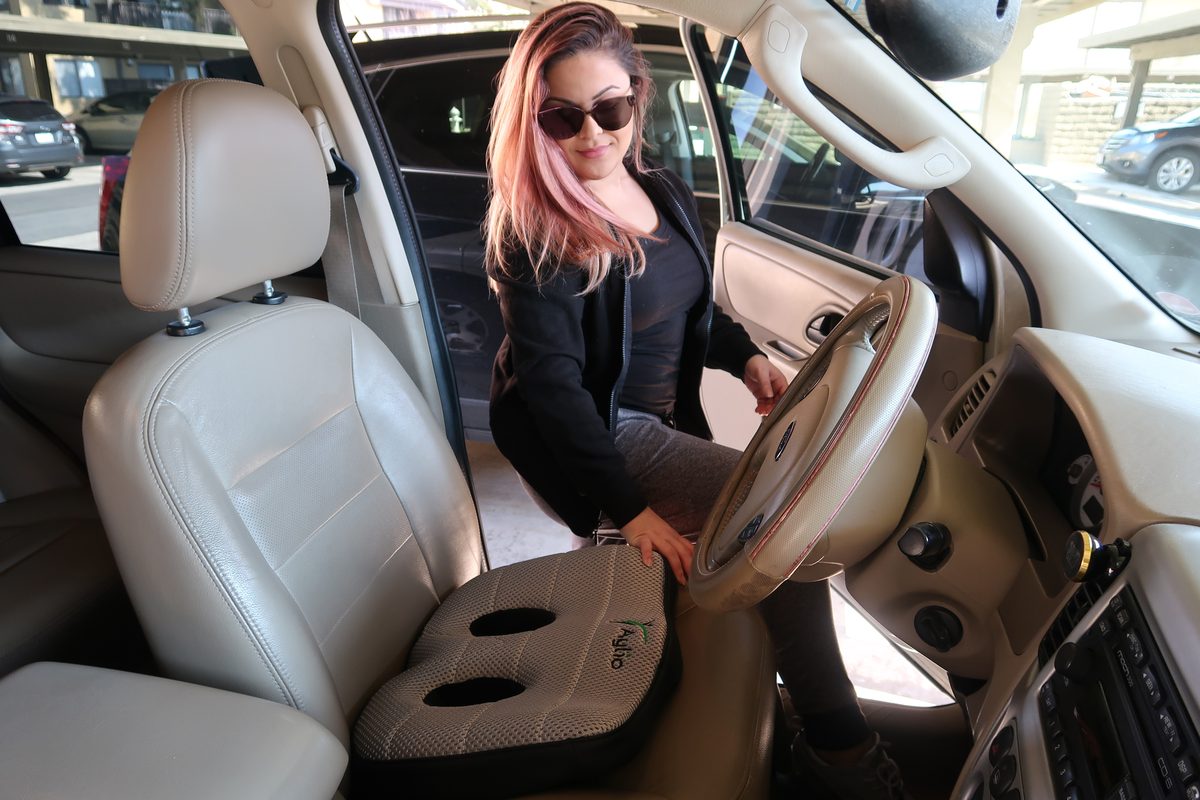
Height is a constraint, not a feature
The Socket Seat is 2.5″ tall. In an office chair you absorb that by lowering the gas cylinder. In a car, about 2″ of added height raises your eyeline, changes the mirror angles you set by habit, moves your head closer to the roof, and changes the angle of your knee and ankle at the pedals. None of that is dangerous if you account for it; all of it is a problem if you discover it merging onto a highway.
Run this check before any long trip:
- Place the cushion all the way back against the seatback and sit on it.
- Lower the seat to its bottom position if your car has height adjustment.
- Reset both mirrors, then confirm you can see the full instrument cluster and the top edge of the windshield without ducking.
- Press each pedal through its full travel with your heel on the floor.
- Drive twenty minutes locally before you commit to a highway day.
Low-roof cars
In coupes and cars with sloping rooflines, about 2″ of added height can put your head against the headliner, and no cushion is worth driving with a tilted neck. If your seat has no height adjustment and headroom is already tight, this is the wrong product for that car. Check that before you order anything.
Depth and width against a bucket seat
The number that decides whether a cushion sits flat is not the seat’s outer width. It’s the width of the flat portion of the pan between the side bolsters. Measure that flat section with a tape, crease to crease.
The Socket Seat is 18.5″ wide and 14.5″ deep. In most sedans, SUVs, and pickups, that measurement comes back wider than the cushion needs, and it sits level. In seats with tall sport bolsters (many sport trims, and any racing-style one-piece bucket), the cushion’s edges ride up on the bolsters, the surface tilts, and the geometry that makes it work is gone. It will not sit flat in those seats, and a cushion that doesn’t sit flat isn’t worth $99.99. Measure before you order.
Depth is more forgiving. At 14.5″ deep, the cushion covers the rear of the pan where your pelvis sits and leaves the front of the car’s own seat to support your thighs, which is where most pans begin curving downward anyway.
Contoured seats and cutout alignment
A rearward-tilted pan rotates the pelvis, and when the pelvis rolls back, the contact points of your sit bones shift. A cushion whose relief zones assume upright desk posture can end up carrying load exactly where it was supposed to remove it.
The Socket Seat’s two openings are each 3.5″ wide, set 6″ apart center to center, with 2.5″ of foam between them. Adult sit-bone spacing runs roughly 4–6″, and the openings are contoured so the moderate pelvic rotation of a normal driving position still leaves the sit bones over open space. Push the cushion fully back against the seatback so the rear groove lines up with your tailbone; if the cushion creeps forward during the drive, the alignment goes with it, which is one reason the non-slip base matters more in a car than at a desk.
Two things about your body could rule it out. A small number of adults measure outside the cushion’s fit range, and nothing about your build predicts it — measure your sit-bone width before buying, not after. And if your pain is at the tailbone rather than under the sit bones, a dedicated coccyx cushion is the better tool; here’s how to tell the two apart. The fit check walks through both questions in about a minute.
Vibration finishes what body weight starts
Soft foam feels right in the first hour and wrong at hour three. It deforms around your anatomy, spreads the load, and lowers peak pressure — briefly. Under sustained body weight it keeps compressing, and once the layer under your sit bones approaches solid, the peak pressure it removed comes back.
A car accelerates that process. Road vibration adds a constant stream of small load cycles, and each one works the foam further toward full compression. A bottomed-out cushion doesn’t just stop relieving pressure; it transmits vibration straight into your sit bones for the rest of the trip. The full argument is in why firm beats soft, but the short version is that only foam dense enough to resist compression can keep the sit bones suspended over the openings from the first mile to the last. The Socket Seat’s high-density foam resists that compression and carries load across the thighs and glutes instead.
The trade-off is real. This cushion is deliberately firm, and the first days feel firmer than whatever it’s replacing. That is the adjustment period, not a defect — but if you want something that feels like a pillow on day one, this isn’t it.
Grip, handle, and moving between vehicles
A few construction details matter more in a car than at a desk:
- The base is vegan leather with a non-slip surface, so the cushion stays in place on fabric and leather seats under braking.
- A carry handle makes it practical to move the cushion between your car, a rental, and your desk chair.
- The zip cover comes off and washes, which matters once coffee and road food are involved.
- The top layer is 3D spacer mesh, an open-weave material that allows some airflow where a solid cover would not.

Take it to mile 200
$99.99 on Amazon with Prime shipping, free returns, and a 100-day trial — long enough to test it on a real road trip, not just the commute. Amazon offers monthly payments at checkout on eligible orders. 4.3 stars across 4,500+ ratings.
Truck, rideshare, and commercial driving
Truck drivers and rideshare drivers sit longer than anyone at a desk, and the seat is not theirs to change. Long-shift driving is the hardest version of this problem: eight to ten hours seated, short breaks, and income that depends on staying in the seat. A few specifics for that case.
Modern air-ride truck seats already isolate much of the road vibration, so in a truck cab the cushion’s job is pressure distribution rather than suspension. The openings and the firm foam still do their work; the vibration argument simply matters less. For rideshare and delivery drivers who move between a personal car and other vehicles, the handle and the non-slip base are the practical features — the cushion transfers in seconds and needs no anchoring. The foam density is tuned for adults of roughly 110–295 lbs, and soft cushions flatten fastest under drivers near the top of that range. And if the ache you drive with lives at the very top of the hamstring — right where you sit — that condition has its own page, because driving is its hardest case.
Planes, and the carry handle
A flight is the long drive with the escape hatch welded shut: a thin, fixed seat, hours at a stretch, and even less room to shift than a car allows. The carry handle sewn into the side lets you lift the whole thing in one hand, so bringing it aboard is no more ceremony than a laptop bag. One honest check before you pack it: at 18.5″ wide it will not sit flat between fixed economy armrests, which usually sit 17–18″ apart. Where the armrests lift, or the seat runs wider, it fits; otherwise it rides in the overhead bin and comes out for the drive at the other end.

If sitting is your job and your sit bones ache even after the shift ends, read sit-bone pain when sitting before deciding a cushion is the whole answer.
The Socket Seat is not a medical device. Pain that persists when you’re out of the vehicle, numbness or tingling in the legs, or pain that wakes you at night are reasons to see a clinician, not to buy a cushion.
Buying checklist
Before you order:
- Measure the flat portion of your seat pan between the bolster creases; you need about 18.5″ of level width.
- Check headroom with about 2″ of height added — sitting on a folded blanket about that thick is a cheap preview.
- Confirm sightlines and full pedal travel at the new height, and reset your mirrors before a long trip.
- Measure your sit-bone width; adult spacing runs roughly 4–6″, and a small number of adults measure outside the 3.6″–6.7″ range the openings are designed for.
- Locate your pain: this cushion’s geometry is built for pressure under the sit bones, and tailbone-first pain points to a coccyx cushion instead.
- Budget an adjustment period for firm foam, and use the 100-day trial on an actual long drive rather than the driveway.
Sixty seconds before $99.99
The fit check runs through seat-pan width, headroom, and sit-bone spacing, then tells you whether this cushion fits your car and your anatomy — or whether you should keep your money.
“I’ve tried so many seat cushions. This is the first one that actually takes the pressure off my sit bones.”
Michael R. · Verified Buyer
Testimonials are individual customers’ accounts; your experience may differ.
Take the pressure off.
A hundred days to find out whether removing the contact point works better than padding it. If it doesn’t, send it back.
4.3 across 4,500+ Amazon ratings · 750,000+ Aylio customers since 2008
Buy on Amazon (opens in a new tab)$99.99 · Prime shipping · Free returns · 100-day trial
Not sure about the fit? Check it in 60 seconds first.