Home For gaming chairs
Locked in
A seat cushion for the marathon gaming session
A gaming chair exists for one job — long hours in the seat — and a few hours in is exactly when it starts to hurt.
$99.99 · Prime shipping · Free returns · 100-day trial
4.3 across 4,500+ Amazon ratings (opens in a new tab) 750,000+ Aylio customers since 2008 Patented Socket Seat® Geometry

- Opening spacing, center to center
- 6″
- Width of each opening
- 3.5″
- Recommended weight range (lbs)
- 110–295
- Days to try it at home
- 100
Below: where that ache actually lives and what leaning into the monitor does to it, then why sculpted racing foam gives out under your sit bones, what a firm cushion with openings changes, the seat-pan check to run before you buy, and what the roughly 2″ of added height means for your armrests and your aim.
Ranked has no five o’clock
A workday has a hard stop. A session has a boss with a health bar, a rank one win away, a queue that turns into four — and past midnight you have been in this chair longer than any office would keep you. Underneath, the physics match any desk chair: most of your upper-body weight arrives through the two bony points at the base of your pelvis, the sit bones (formally, the ischial tuberosities), and the layer of muscle and fat between bone and foam packs down a little more for every hour you stay planted. That slow flattening is why a chair that felt fine at the loading screen has your butt aching by the third hour.
Gaming stacks one mechanic on top. When a round tightens, you come off the backrest and perch on the front half of the seat, nose toward the monitor. The perch rolls your pelvis forward and lifts weight off your thighs, funneling it onto the front of the sit bones. Lean back between matches and the load spreads out again; clutch up and it stacks back onto the two points. Alternate like that for six hours and the ache arrives even in a chair that cost more than your GPU.
If the soreness no longer ends when the session ends — it follows you to bed, or greets you before you sit down — read sit-bone pain when sitting before you spend anything, because some of those aches are not a cushion’s job.
Why sculpted racing foam gives out under you
A racing-style seat is a sculpture, and sculpting demands soft foam. Soft is what lets the seat sweep up into bolsters, mold around your legs, and feel instantly snug in the unboxing video — the first sit is often the best sit that seat will give you. Under your sit bones, though, soft foam can only compress so far — and a marathon session uses that up well before the night ends. It can bottom out early, and from then on bone presses through a crust of spent padding toward the pan. The chair may not be getting worse at hour four at all — it may have finished getting worse long before, and hour four is simply when your tissue runs out of slack too.
Marathon hours also age foam faster than office hours. Foam held compressed slowly loses its spring-back, and the loss grows with time under load — a nightly habit can put more hours on a seat in a year than a nine-to-five does. That is why an aging gaming chair goes flat exactly where you sit while the bolsters stay factory-crisp. Dropping a soft memory-foam pad on top restarts the same countdown with an extra step; why firm beats soft covers the full sequence.
Nothing touching the sit bones, on purpose
The Socket Seat quits the padding contest at the two points where every foam loses it. Two contoured openings — each 3.5″ wide, set 6″ apart center to center, with 2.5″ of firm foam between them — leave the sit bones resting over open space, while your thighs and glutes carry the weight on firm foam built to resist progressive sink-in through a long session. A groove at the rear does the same for the tailbone. Foam that never touches a bone cannot bottom out against it, at hour four or hour ten.
On a gaming chair, the cushion works as a firm platform laid over the chair’s own soft seat: the chair’s foam now pads the platform instead of your pelvis. Adult sit-bone spacing runs roughly 4–6″, and the openings are contoured so most of that range lands over air. It is the cutout-cushion idea, built so the cutouts survive being sat on — why most cutout cushions fold under you is covered at cutout cushions, explained.

Take it into ranked
$99.99 on Amazon with Prime shipping, free returns, and a 100-day trial — enough nights to judge it on your own sessions rather than a first impression. Amazon offers monthly payments at checkout on eligible orders. 4.3 stars across 4,500+ ratings.
Measure your seat pan before you spend a dollar
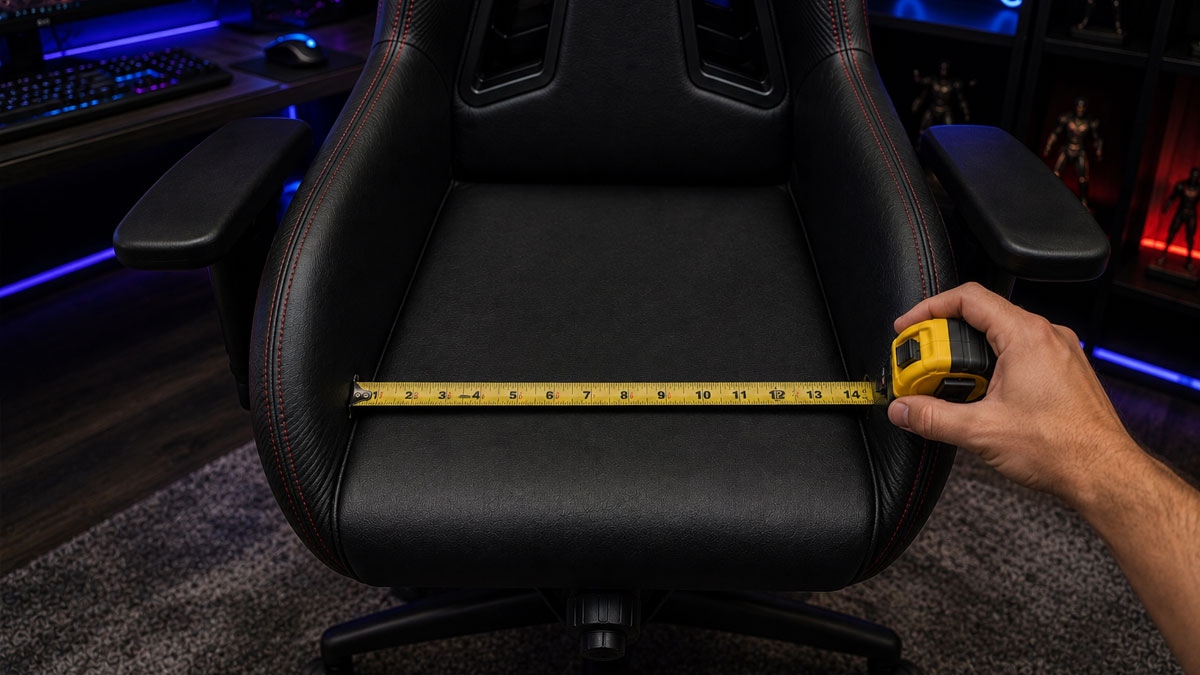
First, the measurement that can rule this cushion out. The Socket Seat is a flat 18.5″ × 14.5″ platform, and a platform needs flat ground. A racing-style bucket with tall side bolsters may not have 18.5″ of level pan between the slopes; set the cushion on top and it bridges the bolsters, rocks, and tilts — and a tilted cushion points its openings somewhere your sit bones are not. Measure the flat section between the bolsters, not the seat’s outer width — the bigger, mostly meaningless number. Flat-pan gaming chairs and office-style gaming chairs give the cushion the ground it needs; deep buckets frequently cannot.
Tall bolsters? Tape measure first
If the level part of your seat pan measures well under 18.5″, this cushion will not sit right in your chair, and your $99.99 should stay in your pocket. No cushion geometry survives being tilted.
Sitting about 2″ higher moves your mouse arm too
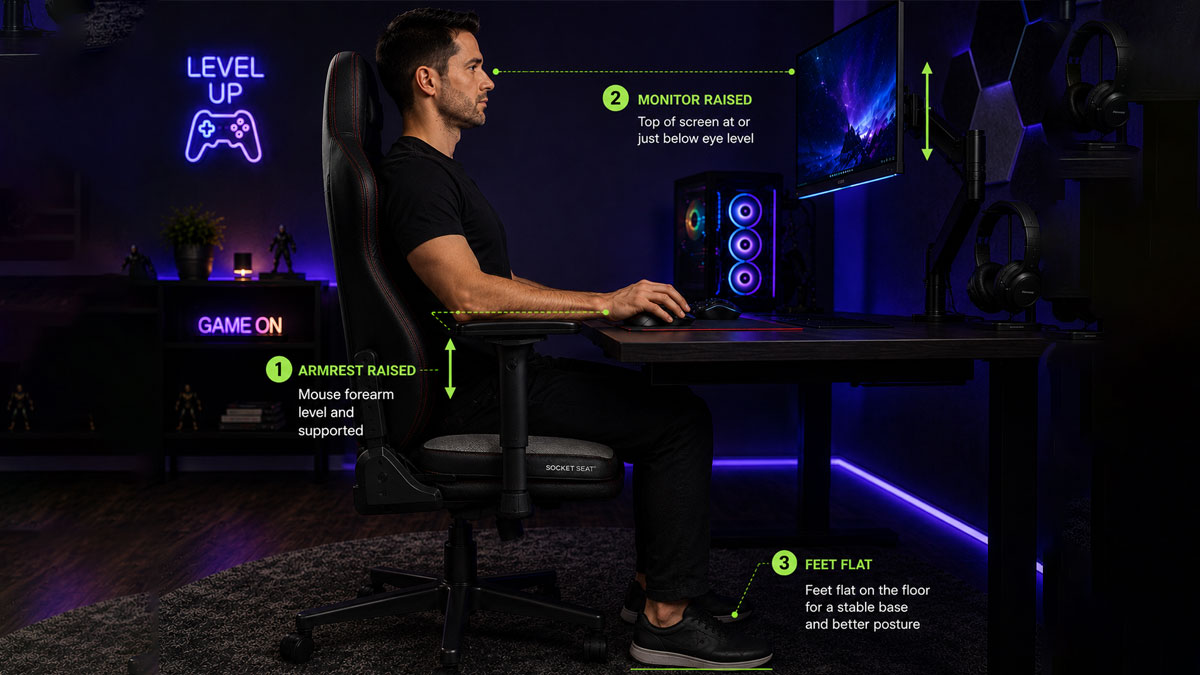
The cushion adds about 2″ of height, and your setup is tuned to the height you sit at today. Armrests are the adjustment that matters most: if your mouse arm anchors on one, that anchor just dropped about 2″ relative to your elbow, and an unsupported elbow shows up in your aim before it shows up as fatigue. Raise the armrests to meet you — check that yours can rise that far — or confirm you aim with your elbow floating. Then the monitor: your eyeline moved up, so the screen should follow. Then your feet: drop the chair cylinder until they plant flat again; braced feet steady your upper body. Ten minutes of re-tuning, or you trade a sit-bone ache for playing tilted in the literal sense. If you also work where you play, the office-chair page walks through the same height reset at a workday desk.
Two more numbers to check against yourself. The foam is tuned for adults from 110 to 295 lbs: lighter and you ride the surface without settling into the contours, heavier and the foam compresses past the depth that keeps the openings open — the full weight-range story is here. And the openings have a target: your sit-bone spacing. Measuring your width takes about a minute and a piece of cardboard, and the fit check turns the number into a clear yes or no before you spend anything. If your sore spot is the tailbone rather than the two points under you, that is a different problem — the rear groove is a courtesy for it, not a solution to it.
The numbers in one place
| Spec | Socket Seat |
|---|---|
| Dimensions | 18.5″ W × 14.5″ D × 2.5″ H |
| Openings | 3.5″ wide · 6″ center to center · 2.5″ of foam between |
| Recommended weight range | 110–295 lbs |
| Cushion weight | 2.5 lbs |
| Core | Firm high-density memory foam |
| Top | 3D spacer mesh (airflow) |
| Base | Vegan leather, non-slip |
| Tailbone | Rear groove keeps it clear of the seat |
| Cover | Zippered, removable, machine washable |
| Materials testing | SGS lab, 2019 — lead, cadmium & six phthalates: none detected |
| Color | Gray/Black |
Two of those rows matter most in long sessions. The 3D spacer mesh top holds a layer of moving air between you and the foam — a difference that matters little in minute five and more by hour five. And the non-slip base grips the seat, so a night of leaning in and settling back does not walk the cushion forward off the pan.
The first week feels like a nerf
Coming from sculpted plush, firm foam is a shock for the first few days. That period is an adjustment, not a defect, and it does not end in softness. The honest test is not tonight against the memory of your chair when it was new; it is next week’s hour four against last week’s. The 100-day trial is sized for that comparison — real sessions, not a first sit — and if firm loses, free returns send the $99.99 back.
The fit check, before you order
Five checks, in order:
- Measure the flat width of your seat pan between the bolsters; the cushion needs about 18.5″ of level ground.
- Check that your armrests can come up about 2″, or that your mouse arm does not rely on them.
- You weigh between 110 and 295 lbs.
- Measure your sit-bone width and run it through the fit page; adult spacing runs roughly 4–6″.
- Plan for a firm first week, and score the cushion at hour four of a real session, not minute one.
If all five clear, the next long session is the actual test — and 100 days with free returns makes it a test that costs you nothing but the time.
The Socket Seat is not a medical device. An ache that persists long after you log off, numbness or tingling down the legs, or discomfort that wakes you at night are reasons to see a clinician, not reasons to buy a cushion.
“I can finally sit through a full workday without constantly shifting around trying to get comfortable.”
Jennifer M. · Verified Buyer
Testimonials are individual customers’ accounts; your experience may differ.
Take the pressure off.
A hundred days to find out whether removing the contact point works better than padding it. If it doesn’t, send it back.
4.3 across 4,500+ Amazon ratings · 750,000+ Aylio customers since 2008
Buy on Amazon (opens in a new tab)$99.99 · Prime shipping · Free returns · 100-day trial
Not sure about the fit? Check it in 60 seconds first.