Every mile you ride passes through two points of bone at the base of your pelvis. How far apart those two points sit is the one measurement that decides whether a saddle supports you or fights you — and it happens to be the same number that sizes everything else you sit on, from an office chair to a cushion with cutouts.
Width first, padding second
On a chair, your thighs and glutes share the work of holding you up. A saddle offers no such committee. Most of your weight funnels through the two bony points at the base of your pelvis — the ischial tuberosities, the bones you sit on — and pressure is force divided by area, so the small patch of saddle under those two points matters more than everything else about the saddle combined.
Where they land decides the ride. Bones squarely on the saddle’s supported width carry load the way they’re built to. On a saddle too narrow for you, they hang past the support and your weight settles onto soft tissue that was never meant to bear it. On one too wide, the saddle’s flanks end up where your thighs need to sweep. Padding rescues neither mistake — soft foam under a misplaced sit bone simply compresses until the load finds soft tissue anyway, which is why a plush saddle can feel worse late in a ride than a firm one that fits.
Getting your number in one minute
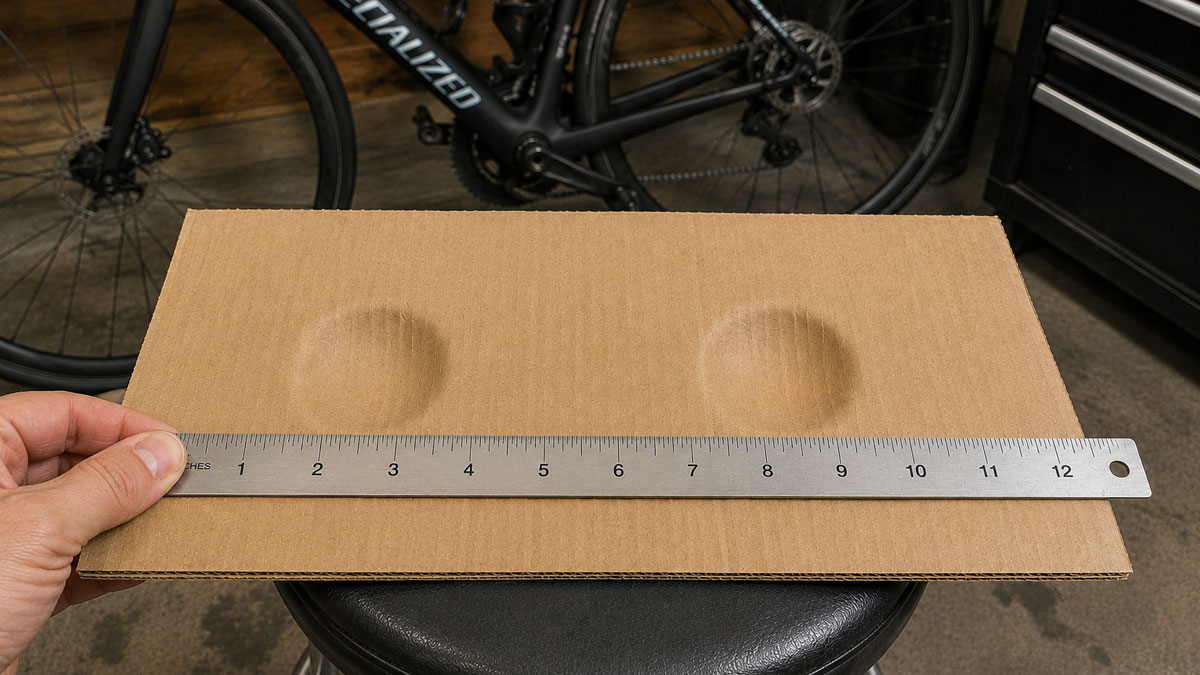
Sit on a piece of corrugated cardboard laid over a hard bench for about thirty seconds, lean forward slightly and lift your feet to sharpen the impressions, then stand up and measure between the centers of the two dents — center to center, not edge to edge. Do it twice on fresh cardboard and trust the average. That’s the whole method; the full walkthrough covers the details and the handful of mistakes worth avoiding. For what the published studies say about typical widths, and how much posture moves the number, see how far apart are sit bones.
If you would rather see it done, the saddle maker Selle SMP filmed the same method in forty-one seconds — cardboard, two dents, measure center to center.
A bike shop measures exactly the same thing with nicer tools — a gel pad or a measuring stool you sit on briefly while the bones leave their marks. The number that comes back is comparable with the cardboard one, because both sides of the counter measure center to center. The method is still part of the number: a pressure mat reads about 7 mm wider than an impression for the same people.
Leaning forward changes the assignment
The cardboard measures you sitting upright, and upright is the honest baseline. A bike rarely keeps you there. Rotate forward toward the hoods or into the drops and your pelvis tips with you; the contact points migrate forward along the pelvis onto structures that sit closer together. Your bones haven’t moved, but the width doing the supporting has effectively narrowed — which is why an aggressive position calls for a narrower saddle than your upright number alone would suggest.
It’s also why the same rider can be comfortable on a trainer and miserable in the drops on the identical saddle. And if a position leaves anything numb, that’s a conversation for a bike fitter first and a clinician if it persists — not something to pad over.
From your number to a saddle width
Want it done for you? The saddle width calculator turns your number and riding position into a width range, with the rules shown.
For an upright position, fitting guides add roughly 30–40 mm to your sit-bone width so both bones sit inside the supported area with margin to spare. SQlab’s scheme runs from about +20 mm for a mountain-bike position to +40 mm, and bike-components’ guide allows up to 4 cm when you sit upright. The more aggressive the position, the smaller the addition, because the effective support width has already narrowed; fully extended, saddle width matches sit-bone width. The calculator shows the sources.
| Riding position | What your pelvis does | What fitters commonly do |
|---|---|---|
| Upright — city bike, cruiser, trainer | Stays vertical; weight lands squarely on the sit bones | Add roughly 30–40 mm to the measurement |
| Moderate — endurance road, gravel, riding the hoods | Tips forward; contact creeps forward and slightly inward | Add roughly 10–30 mm — less the further forward you lean |
| Aggressive — drops, time trial | Rotates well forward; support shifts to narrower structures | Add little — the narrowest saddles start to fit |
Every maker’s chart is its own country
The allowance above is a convention, not a standard. Saddle makers publish their own sizing, shells differ in shape as much as width, and two saddles wearing the same printed number can support you differently. The cardboard gets you to the right shelf; if a local shop offers a proper measurement and test saddles, that’s how you pick from it.
The same number, off the bike
Here’s what almost nobody tells a cyclist: the number you just went to all that trouble for has a second job. A cutout desk cushion is fixed geometry making the same bet a saddle makes — that its support will land where your pelvis needs it — and both worlds size that bet center to center.
The Socket Seat is our version of the bet: two openings positioned so the sit bones rest in open space while firm foam carries the load across the thighs and glutes. The openings are 3.5″ wide, spaced 6″ center to center, with 2.5″ of foam between them, and the geometry suits sit-bone widths of roughly 3.6–6.7″. For how that logic plays out across the whole cutout family — donuts, notches, twin openings — see what the holes are actually for.
To be plain: Aylio makes seat cushions, not saddles. We can’t size your saddle beyond the table above, and a good bike shop can. What your saddle number can do here is answer a different question in about ten seconds — whether the chair you sit in all day deserves the same fit logic your bike already got.
Already have your number?
Whether a fitter’s stool produced it or a cardboard box did, the fit checker takes your width and answers plainly: a good match for the Socket Seat’s geometry, a borderline one, or not your cushion. It says that last part out loud, too.

Saddle-fit logic for the desk chair
Openings 6″ apart, center to center — support where your anatomy wants it, open space where it doesn’t. $99.99 on Amazon, 4.3 stars across 4,500+ ratings, 100-day trial, free returns.
Measure once, use it twice
Sit-bone width is a skeletal dimension. It won’t change with your training block, the season, or the number on the scale, so it’s worth the minute to measure well and worth writing down. A saddle, an office chair, a long drive, a cushion with openings — each is a bet on where two points of your body land. Once you know the number, none of them has to be a guess.
This is education, not medical advice. Aylio makes ergonomic seat cushions, not medical devices. Nothing here is intended to diagnose, treat, cure or prevent any condition, and a cushion is not a treatment. If numbness, saddle sores, or pain persist — on the bike or off it — see a doctor or a licensed physical or occupational therapist. They can examine you; an article cannot.