If you’re shopping for a bike saddle, an office chair, or a cushion built around cutouts, one measurement decides whether the thing will work for you: the distance between your sit bones — also called sitting bones or sitz bones.
It takes about a minute to find, and you almost certainly have everything you need already.
What you need
- A piece of corrugated cardboard — a flattened shipping box is ideal. Not thin card; it needs to hold a dent.
- A hard, flat bench, stool or chair. Not padded.
- A ruler or tape measure.
Some guides use aluminum foil over carpet, or a sheet of paper on a memory-foam pad. Those work too. Cardboard is the most reliable because the dents stay put while you go find the ruler.
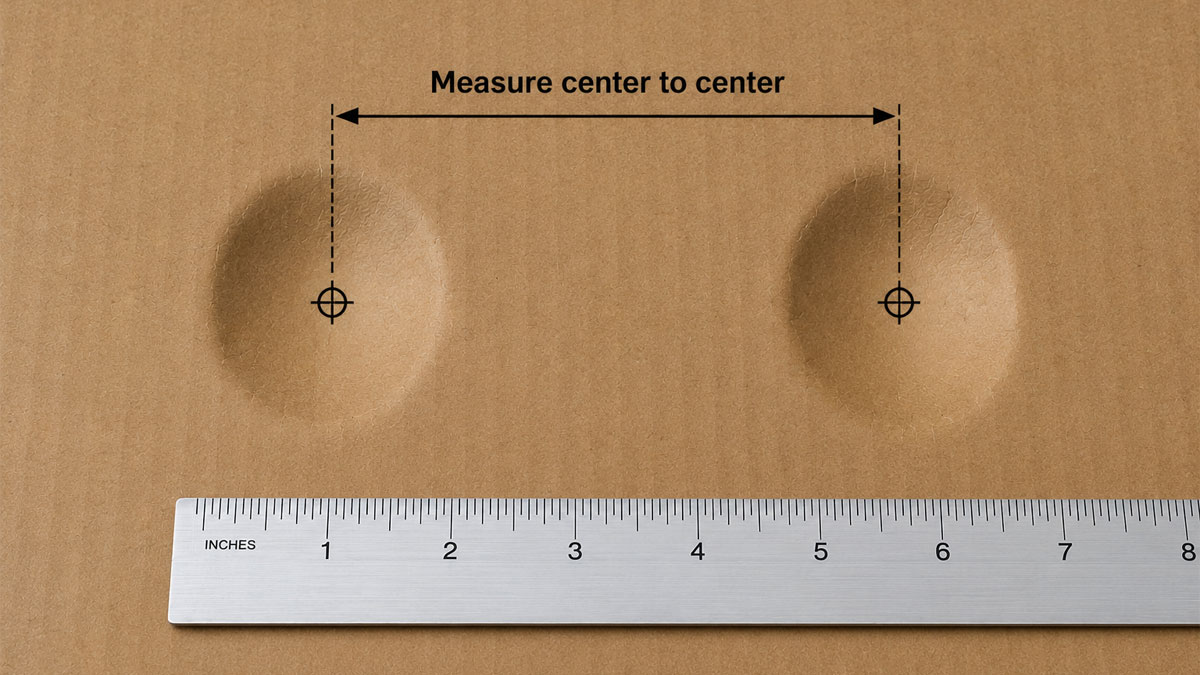
The method
- Put the cardboard on the hard surface. A padded chair will spread the load and blur the dents.
- Sit down normally and stay there for about 30 seconds.
- Lean forward slightly and lift your feet off the floor for a few seconds. This rotates your pelvis so more weight goes through the sit bones, which sharpens the impressions.
- Stand up carefully — don’t slide off, or you’ll smear the marks.
- Find the two dents. They’re shallow. Tilting the cardboard toward a light source makes them much easier to see.
- Measure center to center, not edge to edge. Mark the middle of each dent with a pen first if it helps.
Rather watch it than read it? The saddle maker Selle SMP filmed the same cardboard method — sit, mark the center of each dent, measure between them. Their example comes out at 13 cm; the units are the only thing that differs from the steps above.
Do it twice
Measure once, then repeat on a fresh patch of cardboard. If the two numbers are within about a quarter inch, trust the average. If they’re far apart, you probably shifted position — try again and keep still. If you want to know how your number compares, the published measurements put most adults between about 100 and 155 mm. Cyclist? The saddle width calculator turns the same number into a saddle size. There is also a one-page measuring card to print for a shop or a clinic.
What the number means
Most adults land between roughly 4″ and 6″. Sit-bone width varies with skeletal structure and on average runs somewhat wider in women than in men — but the spread within any group is far larger than the difference between groups, which is exactly why measuring beats assuming.
There is no good or bad number here. It’s a dimension, like shoe size.
For a bike saddle
Saddle sizing adds roughly 10–40 mm to your sit-bone measurement depending on riding position — less the further forward you lean, because the bones then sit on a different part of the saddle. Most saddle makers publish their own sizing chart — use theirs, not a generic rule; the saddle width calculator shows the published allowances.
For a cutout cushion
Here the logic is more direct. A cushion with two openings is trying to put empty space exactly where your sit bones land. So you want your measurement to land inside the designed range — about 3.6″ to 6.7″ for openings set 6″ apart and 3.5″ wide. The openings are wide, so your bones do not need to sit at their exact centers.
Far narrower than that and both sit bones land on the 2.5″ bridge between the openings; far wider and they land outside them. Either way you get a firm cushion with two holes that aren’t doing anything.
If the openings miss your sit bones
This is the question most cushion brands would rather you didn’t ask, because the answer sometimes disqualifies their product. A cutout design that doesn’t line up with your anatomy isn’t a mediocre cushion — it’s just a firm one.
Where the Socket Seat sits
The Socket Seat’s openings are spaced 6″ center to center. Our fit checker takes your measurement and tells you plainly whether that’s a good match, a borderline one, or a mismatch — including the cases where we’d rather point you elsewhere.

Openings 6″ apart, center to center
Your number either lands in the openings or it doesn’t — and the 100-day trial settles the borderline cases. $99.99 on Amazon, 4.3 stars across 4,500+ ratings, free returns.
For what your number means for each cutout shape — donuts, notches and twin openings — see what the holes are actually for.
A few things that throw the measurement off
- Sitting on a soft surface. The load spreads and the dents never form clearly.
- Thick clothing. A heavy coat or thick jeans will blur the impressions. Normal clothes are fine.
- Slouching. Rolling back onto your tailbone shifts weight off the sit bones — you’ll get faint marks in the wrong place.
- Measuring edge to edge. Use the centers. Edge-to-edge overstates the distance.
If you are not yet sure the sit bones are the problem, check that first — the two need opposite cushion shapes. Once you have the number, write it down. It’s useful well beyond one purchase — saddles, chairs, and cushions all reference it, and it isn’t going to change.