Home Fit checker
Fit checker
First, make sure it fits you.
This cushion only works if your sit bones land in its two openings. If they don’t, better to know now, while it costs you nothing. A minute and a hard chair is all it takes. No cardboard to hand? In four published studies, every measured group averaged inside the range (the numbers) — and the 100-day trial covers the rest.
Already measured? Skip to the checker
No cardboard right now, and wondering whether your height or build already answers it? What your body actually tells you — short version: less than you would think.
Step 1 — Measure your sit bones
You need a piece of corrugated cardboard and a ruler. That’s it.
- Put the cardboard on a hard, flat bench or chair — not a padded one.
- Sit on it for about 30 seconds.
- Lean forward a little and lift your feet, so more of your weight goes through your sit bones.
- Stand up. You should see two shallow dents.
- Measure between the centers of the two dents, in inches. Working in centimeters? Divide by 2.54 — 11.5 cm is 4.5″.
If balancing with your feet up feels unsteady, keep your hands on the seat and skip the lift — the dents will just be fainter. No dents at all? Sit a little longer, or use a softer single-layer piece of cardboard. And it is fine to lift the cardboard onto a table to measure instead of bending down to it.
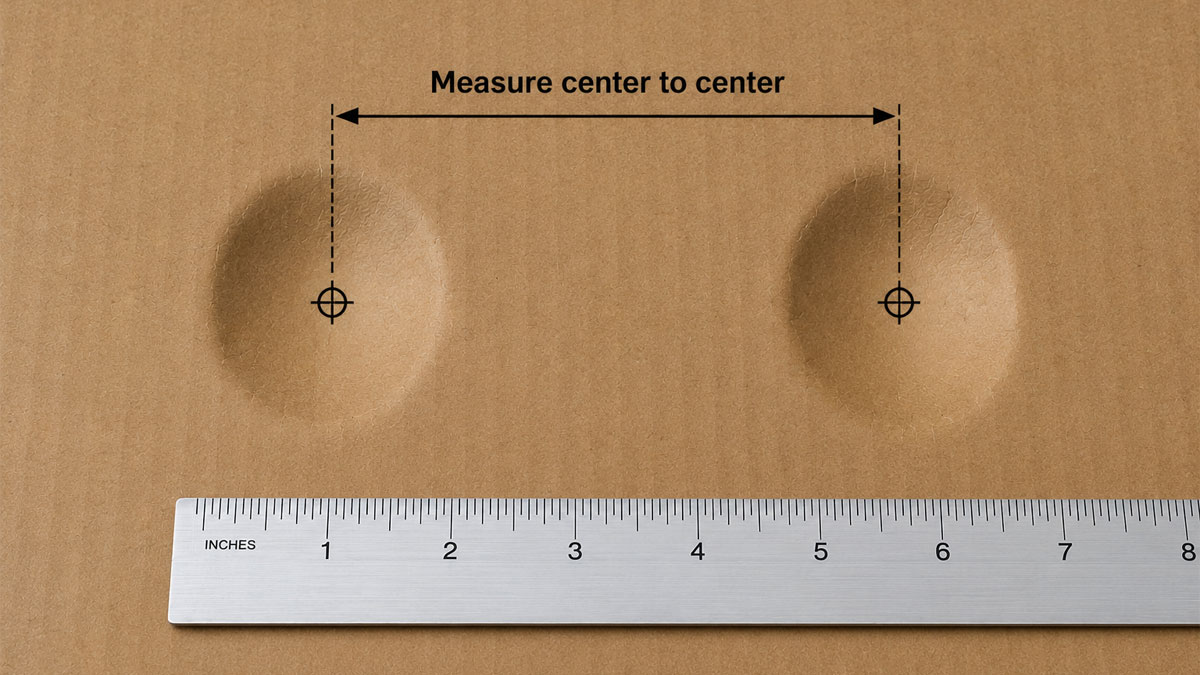
Most adults land somewhere between 4″ and 6″. For the longer version of this method, see measuring your sit-bone width at home. Cyclist? The same number sizes a saddle — saddle width calculator. There is no “good” or “bad” number — it’s just anatomy.
Step 2 — Check it against the openings
The Socket Seat’s openings sit 6″ apart, center to center (3.5″ wide each, with 2.5″ of foam between them).
Not sure whether your pain is even a sit-bone problem? Tailbone pain and sit-bone pain need opposite cushion shapes — worth two minutes before you buy.
Never sat on a cutout cushion? Seat cushions with cutouts, explained covers the three shapes and who each one fits.
Want to see it rather than read a number? Print the openings at actual size (PDF, one landscape page) and lay your cardboard on top — it carries a ruler so you can confirm your printer did not scale the page.
This is guidance, not a guarantee — how you sit matters as much as the measurement. The 100-day trial is the real test.
What sit-bone width fits the Socket Seat?
The same answer the checker gives, as a table. The range is a performance window, not a bone-contact boundary: inside it, the openings do their job under your sit bones and the bridge of foam stays between them; borderline means you are just past its edge — the people who land there often do well, but we would not promise it.
| 3.6″ to 6.7″ | Good fit — inside the range the geometry is designed around |
|---|---|
| 3.3″ to 3.6″ or 6.7″ to 7.0″ | Borderline — just past the edge of the designed range; the 100-day trial is built for this case |
| Under 3.3″ | Below the designed range — the geometry will not work as intended for you |
| Over 7.0″ | Above the designed range — the geometry will not work as intended for you |

Typical adult sit-bone width runs roughly 4–6″. All of that span lands in the good range — the measurement is how you find out whether you are one of the few people outside it. What the published studies measured.
Step 3 — Check the chair, not just yourself
The geometry can be right for your body and still wrong for your seat. Four things worth checking before you order.
- Seat width You need about 18.5″ of usable width. Chairs with fixed side bolsters — gaming chairs and many car seats — can leave the cushion perched on top of the bolsters instead of settled between them.
- Seat depth At 14.5″ deep it fits most seats. If your seat pan is much shallower, the front edge will overhang — usually fine, occasionally annoying against the backs of your knees.
- Headroom It raises you about 2″. Most drivers find that improves sightlines. In a low-roof car, sit up straight and check you have at least two inches of clearance to spare before you commit.
- Desk height Raising your seat about 2″ changes your relationship to the desk. If your chair is already at its lowest and your elbows are tight to the desktop, factor that in.
None of these are dealbreakers on their own — but they are the four things people tell us they wish they had measured first. Driving in particular has its own constraints — the long-drives page covers headroom, seat shape and vibration.
Full specs
| Dimensions | 18.5″ W × 14.5″ D × 2.5″ H |
|---|---|
| Opening width | 3.5″ each |
| Opening spacing | 6″ center to center |
| Recommended weight range | 110–295 lbs |
| Cushion weight | 2.5 lbs |
| Core | Firm high-density memory foam |
| Top | 3D spacer mesh (airflow) |
| Base | Vegan leather, non-slip |
| Cover | Zippered, removable, machine washable |
| Materials testing | SGS lab, 2019 — lead, cadmium & six phthalates: none detected |
| Color | Gray/Black |
Two checks before you buy
The added height — about 2″ — helps a lot of drivers see better, but it can feel tall in a low-roof car — check your headroom.
If your measurement is under 3.3″ or over 7.0″, you are outside the range this geometry is designed for, and the cushion will not work as intended for you. We’d rather tell you that now.
Measured up?
If your number landed in the range, the rest is a hundred days in your own chair.
4.3 across 4,500+ Amazon ratings · 750,000+ Aylio customers since 2008
Buy on Amazon (opens in a new tab)$99.99 · Prime shipping · Free returns · 100-day trial
Your measurement landed outside the range this geometry is designed around, so there is no button here for you. If the sore spot is one point on the midline rather than two either side, that is a different problem with a different shape.