Home For hard chairs
At the table
A seat cushion for the chair that gives nothing back
A hard chair doesn’t build up to hurting — it starts there.
$99.99 · Prime shipping · Free returns · 100-day trial
4.3 across 4,500+ Amazon ratings (opens in a new tab) 750,000+ Aylio customers since 2008 Patented Socket Seat® Geometry

- Opening spacing, center to center
- 6″
- Width of each opening
- 3.5″
- Recommended weight range (lbs)
- 110–295
- Days to try it at home
- 100
Wood gives nothing back, so the two bones at the base of your pelvis take their peak pressure from the first minute, which is how one hour at the dining table can outhurt three at a desk. Here is why hard seats hurt this fast, why the thin tie-on pad barely helped, what two openings change on a base with zero give, and the two measurements — seat size and table clearance — to take before you order.
Wood doesn’t wait
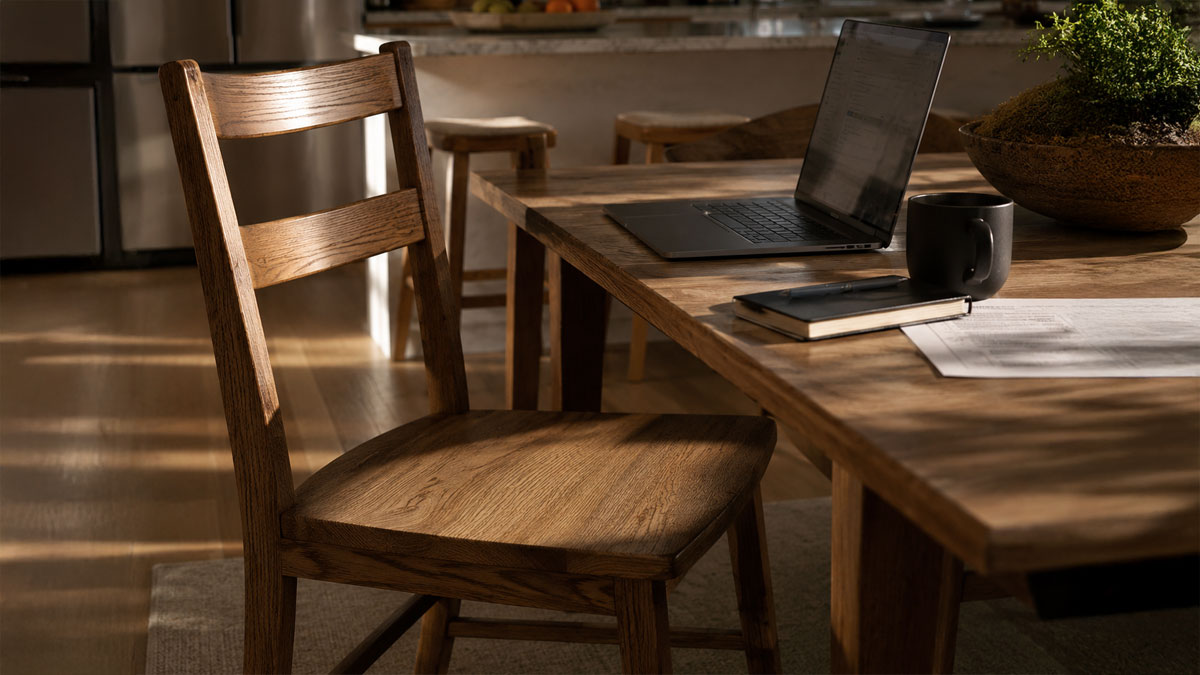
A padded chair hurts on a delay: its foam flattens over hours, and the ache clocks in mid-afternoon. Wood skips the delay. Most of your upper-body weight lands on two small bones at the base of the pelvis, and a hard seat meets them with full pressure the moment they arrive — there is no foam to spend, so there is no grace period. The pressure an office chair takes all morning to build is already present before the food reaches the table.
That head start is why the kitchen-table workday is a harsher sit than the office it replaced. The chair under you was built for the length of a dinner and is now pulling eight-hour shifts beside a laptop. If the soreness has started following you out of the chair or showing up daily, read sit-bone pain when sitting before buying anything; a cushion is not always the right move.
Why the tie-on pad changed nothing
The obvious fix is a thin chair pad, and you may already own the evidence against it. However thick a pad’s soft filling is, that thickness is all the compression distance it has, and your sit bones use it up in the first second. Under the two points that matter, the pad presses flat against the board and stays flat; everywhere else it stays puffy, which is why it still looks inviting long after it has stopped doing anything. A soft pad on a hard seat upgrades the first minute and nothing after it.
Thicker soft foam only stretches the same collapse from a second into a few minutes. Softness is the wrong axis entirely: material that compresses easily finishes compressing precisely where your weight concentrates, and on a board there is no second layer underneath to catch what the pad lets through. The full argument is in why firm beats soft; the short version is that a hard chair doesn’t need padding to crush — it needs the load routed around the bones.
Openings matter most where the seat gives least
The Socket Seat leaves the two points that wood punishes with nothing to press against. Two contoured openings — each 3.5″ wide, centers 6″ apart, with 2.5″ of foam bridging them — hold your sit bones over open space while your thighs and glutes, surfaces that carry load well, take the weight on the firm foam around them.
Geometry earns more on wood than anywhere else. On a padded chair, a bone that lands a little off its opening still has the chair’s own foam beneath as a consolation prize; a wooden chair offers none, so a miss is bone on foam on board. That is why the openings are contoured around typical adult sit-bone spacing — roughly 4–6″, all of it inside their designed range — and why the core is high-density foam rather than anything cozy: an unyielding base pushes back with everything you give it, and soft walls around a cutout would smear flat against it. Firm walls are what keep the openings open at full load. The wider case for cutout designs — including where they lose — is at cutout cushions, explained.
The underside matters on wood too. The base is non-slip vegan leather, because a varnished seat gives an ordinary cushion nothing to hold onto, and a cushion that skates toward the table edge is one you will stop fetching. (On an unusually slick finish, some customers add a thin non-slip rubber mat underneath, cut to the cushion’s size so it disappears under it.) A groove at the rear keeps your tailbone clear of the surface — though if the tailbone is where the pain actually lives, sort the two apart first, because that is a different problem with a different tool. Up top, a 3D spacer mesh keeps air moving through a long dinner.

Bring it to dinner
$99.99 on Amazon with Prime shipping, free returns, and a 100-day trial — enough dinners and kitchen-table shifts to know, on your own chairs, whether the openings are worth it. Amazon offers monthly payments at checkout on eligible orders. 4.3 stars across 4,500+ ratings.
Measure the seat, because many dining chairs are too small
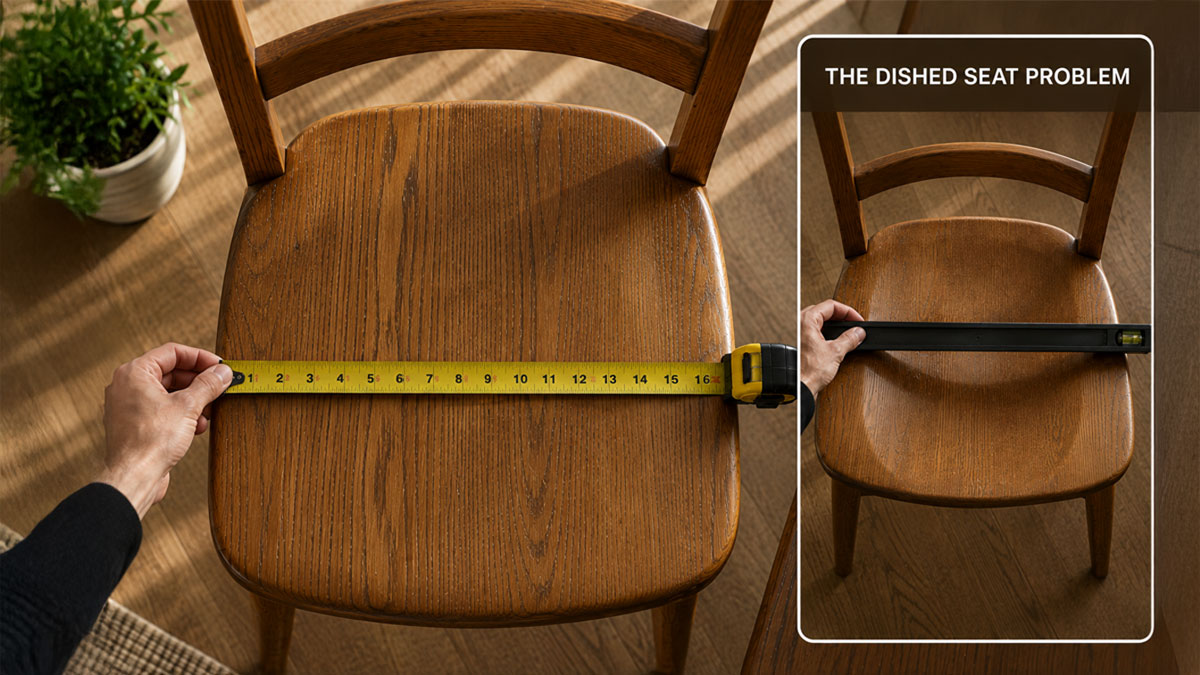
The cushion is 18.5″ wide and 14.5″ deep, and it needs a mostly flat seat at least that large. Dining chairs are among the least standardized seats you own: plenty run narrower than 18.5″ across, and many wooden ones are dished — carved slightly lower in the middle than at the rim. Run a tape across the surface you actually sit on, not the chair’s outer frame, and lay a straightedge across the seat to see how deep any scoop goes.
A scooped seat rocks the cushion
On a deep dish the cushion bridges from rim to rim and teeters instead of sitting planted; on a seat narrower than 18.5″ its edges hang past the wood and fold under your thighs. Either way the geometry stops sitting level under you. If your chairs are heavily sculpted, this is the wrong cushion for them — keep your money, or use the cushion on a flatter chair you already have. Whether a better chair or this cushion should come first is its own question; here is the decision rule.
The table doesn’t move
An office chair swallows the cushion’s added height with one pull of a lever; a dining table concedes nothing. The top stays where it is and most dining chairs can’t drop, so you rise about 2″ toward the tabletop. Your forearms meet the table at a new angle, and your knees ride about 2″ closer to the apron — the rail under the tabletop. Before ordering, measure the space between the top of your thighs and the underside of the table where you usually sit: without a spare 2″ there now, your knees will find the apron before your elbows settle. For a meal the rise rarely matters; for a full workday at a fixed-height table, it decides whether the whole setup works.
Benches and stools put everything on two points
A backrest quietly takes a share of your weight. A bench hands that share back: with nothing behind you, you sit fully upright or tip slightly forward, and either way the load lands squarely on the sit bones — which is why a hard bench announces itself even faster than a hard chair. The mechanism suits that upright posture, but the furniture has to cooperate. The full 18.5″ × 14.5″ footprint needs flat support: most benches offer it, many stools don’t, and a round stool top smaller than the cushion leaves its corners floating in air. Perching is the other trap. A stool invites you onto its front edge, and the cushion works only when you sit fully onto it, sit bones over the openings rather than ahead of them.
The numbers in one place
| Spec | Socket Seat |
|---|---|
| Dimensions | 18.5″ W × 14.5″ D × 2.5″ H |
| Openings | 3.5″ wide · 6″ center to center · 2.5″ of foam between |
| Recommended weight range | 110–295 lbs |
| Cushion weight | 2.5 lbs |
| Core | Firm high-density memory foam |
| Top | 3D spacer mesh (airflow) |
| Base | Vegan leather, non-slip |
| Tailbone | Rear groove keeps it clear of the seat |
| Cover | Zippered, removable, machine washable |
| Materials testing | SGS lab, 2019 — lead, cadmium & six phthalates: none detected |
| Color | Gray/Black |
The weight range gets its own page: foam mechanics set it at both ends, and the bigger-bodies page explains where it comes from and what happens past it.
A firm first week is part of the deal
Whatever this cushion replaces, it will feel firmer than that for the first several days. Firmness is not a flaw to wait out; it is the property doing the work, because a surface that carries your thighs while skipping your sit bones cannot also be plush. Judge it after a week of real dinners and real workdays rather than on the first sit, and let the comparison be hour one on the wood against hour one on the cushion.
Before you order
Five minutes with a tape measure settles most of this:
- Measure the seat’s flat area: at least 18.5″ side to side and 14.5″ front to back, with no deep scoop.
- Measure thigh-to-table clearance where you sit most, and confirm a spare 2″.
- Confirm you’re between 110 and 295 lbs.
- Measure your sit-bone width: widths of roughly 3.6–6.7″ are inside the designed range, with 3.3″ and 7.0″ as the borderline edges. The fit check turns your number into a yes or no.
- On a bench or stool, plan to sit fully on the cushion, never perched on its front lip.
- Expect the firm week, then run the 100-day trial across real meals and workdays — free returns mean a wrong guess costs you nothing.
The Socket Seat is not a medical device. Soreness that lingers after you stand, numbness or tingling down the legs, or pain that disturbs your sleep belongs in front of a clinician, not under a cushion.
“I almost didn’t buy it because of the price. Now I wish I’d found it years ago.”
David K. · Verified Buyer
Testimonials are individual customers’ accounts; your experience may differ.
Take the pressure off.
A hundred days to find out whether removing the contact point works better than padding it. If it doesn’t, send it back.
4.3 across 4,500+ Amazon ratings · 750,000+ Aylio customers since 2008
Buy on Amazon (opens in a new tab)$99.99 · Prime shipping · Free returns · 100-day trial
Not sure about the fit? Check it in 60 seconds first.